

Up to 40% off
Glassware
Shop
Bar Accessories
Get 30% off
Tableware
Shop
Refrigeration

Save Up To 30%
Front of House
Shop
Kitchen Accessories
Shop
Catering Equipment
Shop
Cleaning
Get 30% off
Disposables
Category
- Catering Equipment Wholesale (7)
- Commercial Cooking Equipment (7)
- Fryers (1)
- Ovens (2)
- Convection Ovens (7)
- Griddles (1)
- Commercial Cooking Equipment (7)
Brand
- Uropa (3)
- Lincat (2)
- Buffalo (3)
- Smeg (1)
- Falcon (1)
Colour
- Black (1)
- Silver (4)
Gastronorm Size
- 1/1 (1)
Material
- Stainless Steel (2)
Power
- Single Phase Electric (1)
Product Type
- Ovens (4)
Warranty
- 2 Years (1)
Price
Min: £
Max: £
Convection Ovens
Showing all 7 results
-
£1,307.00 Ex. VAT
-
£314.67 Ex. VAT
-
£798.51 Ex. VAT
-
£582.92 Ex. VAT
-
£1,275.74 Ex. VAT
-
£275.60 Ex. VAT

Showing all 7 results
Commercial Convection Ovens for Professional Kitchens
A commercial convection oven uses a built-in fan to circulate hot air evenly around the cabinet – every shelf cooks at close to the same temperature, every time. That means faster bake times, more even browning and fewer reloads than a static oven. For a kitchen running pastries, bread, pies or roasted proteins at volume, it’s the difference between consistent output and constant adjustment.
Ascot Wholesale stocks commercial convection ovens from Buffalo, Lincat, Falcon and Smeg – countertop and freestanding models, 21L to 100L capacity, for bakeries, restaurants, pubs, cafés and contract catering kitchens. Trade pricing, reliable stock, UK delivery.
How to Choose a Commercial Convection Oven
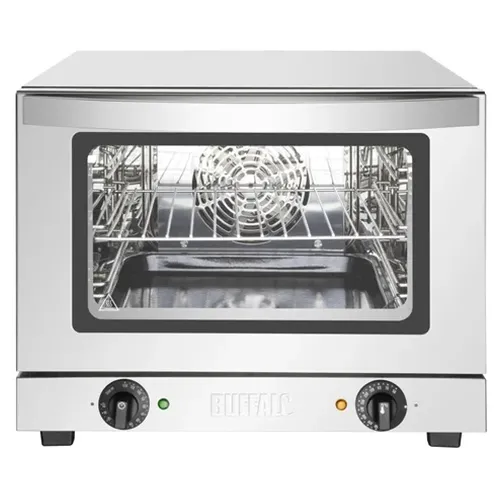
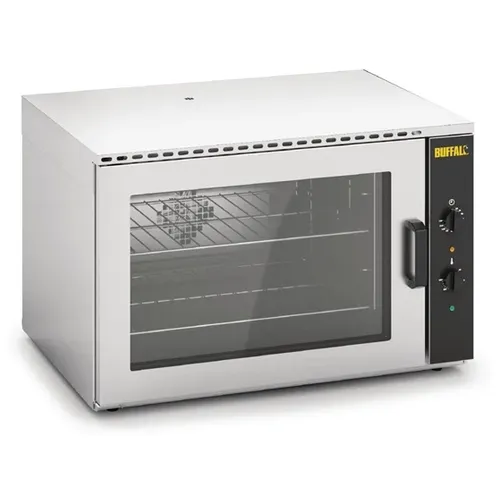
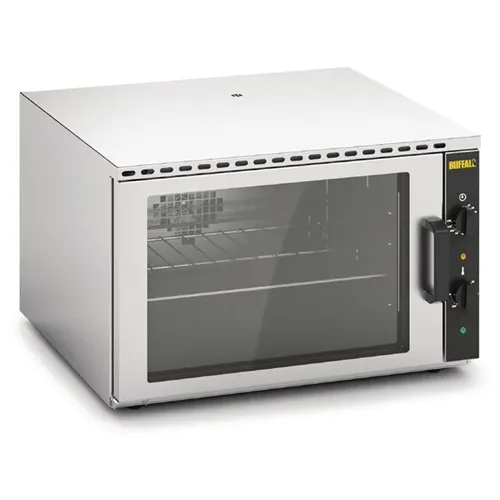
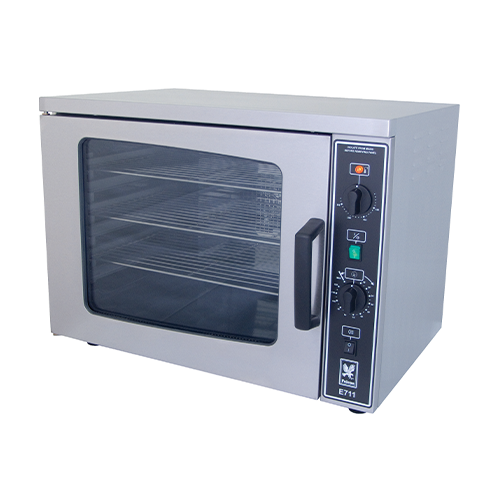
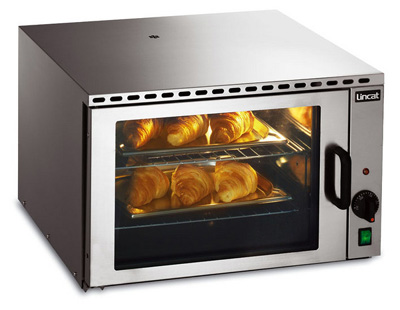
- Countertop vs freestanding – Countertop models (Buffalo 21L, Lincat Lynx 400) suit smaller operations or kitchens with limited floor space. Freestanding models (Buffalo 50L and 100L) handle higher volume – multiple trays running simultaneously through a full service.
- Capacity and tray count – Match capacity to your peak production, not your average. A 50L oven typically runs 3–4 GN 1/1 trays simultaneously. A 100L model handles 5–6. Don’t cram trays – blocked airflow kills the fan circulation advantage and produces uneven results.
- Electric vs gas – Most commercial convection ovens in this range are electric. Electric models are easier to install, offer precise temperature control and suit most UK catering kitchens. Gas convection ovens suit high-volume operations already on gas with a preference for lower running costs per hour.
- Temperature range – Commercial convection ovens should reach at least 250°C for roasting and baking. Check the maximum temperature on the spec sheet – some countertop models cap lower and suit reheating and pastry work rather than full roasting.
- Fan speed control – Variable fan speed matters for delicate baking – soufflés, pastries and bread prove better with lower fan speeds. Fixed-speed models suit operations running robust proteins and baked goods where airflow intensity isn’t a concern.
Trade Insight
Fan circulation is only as good as the load you put in. Cram trays too close together and you block the airflow – you’re right back to the uneven results of a static oven. Leave adequate spacing between trays and don’t overload the cavity. A 50L oven running 3 well-spaced trays outperforms a 100L oven stuffed to capacity every time.
Temperature reduction vs static ovens. Commercial convection ovens cook faster and more evenly than static ovens – as a rule of thumb, reduce your recipe temperature by 15–20°C and check finish times earlier than you would with a static oven. Kitchens that don’t adjust end up with over-browned exteriors and underdone centres on the first few runs.
Countertop models suit supplementary capacity, not primary production. A 21L countertop convection oven is ideal for a café running pastries and reheating alongside a main range. It’s not the right tool for a restaurant running 100 covers of roasted proteins. Match the unit size to the production role – supplementary or primary.
Clean-down frequency determines how long the unit lasts. Grease and food residue build up on the fan housing and cavity walls. A convection oven with a blocked or grease-coated fan runs less efficiently and produces less even results. Wipe down the cavity after every service and deep-clean the fan housing weekly on high-use units.
Why Buy from Ascot Wholesale
- Competitive trade pricing – across the full commercial convection oven range.
- Trusted brands – Buffalo, Lincat, Falcon and Smeg, used daily in real UK catering operations.
- Countertop and freestanding models – 21L to 100L capacity for every kitchen size and production volume.
- Free delivery on qualifying orders – across the UK mainland.
- Trade accounts for regular buyers – restaurants, bakeries and contract caterers placing ongoing orders.
- 25 years supplying UK hospitality – trade authority built on real commercial experience across restaurants, bakeries and contract catering operations.
Browse our full Cooking Equipment range, or explore related categories: Commercial Ovens and Commercial Pizza Ovens.
Frequently Asked Questions
What is a commercial convection oven and how does it work?
A commercial convection oven uses a built-in fan to circulate hot air continuously around the cavity. This eliminates hot and cold spots, so every shelf cooks at close to the same temperature. The result is faster, more even cooking than a static oven – particularly valuable for baking, roasting and reheating at volume.
What’s the difference between a commercial convection oven and a standard static oven?
A static oven relies on radiant heat from elements – the top shelf runs hotter than the bottom, and results vary across the cavity. A convection oven circulates air with a fan, producing even temperature distribution across all shelves. For volume baking and roasting, convection ovens are significantly more consistent and efficient.
Should I choose a commercial electric or gas convection oven?
Most commercial convection ovens in the UK are electric – easier to install, precise temperature control, no gas connection required. Gas convection ovens suit high-volume operations already on gas where lower running costs per hour are a priority. For most UK restaurant and bakery kitchens, electric is the practical choice.
What capacity commercial convection oven do I need?
Size to your peak production, not your average. A 50L model runs 3–4 GN 1/1 trays simultaneously and suits most restaurant and café operations. A 100L model handles 5–6 trays and suits higher-volume production kitchens. Countertop models (21L) suit supplementary capacity or smaller operations.
Are commercial convection ovens suitable for baking bread and pastries?
Yes – commercial convection ovens are widely used in bakeries and café kitchens for bread, pastries, pies and cakes. For delicate items, reduce fan speed if variable speed is available, and reduce recipe temperature by 15–20°C versus a static oven. Even heat distribution produces consistent browning across all trays simultaneously.
Does Ascot Wholesale offer trade accounts for commercial convection ovens?
Yes. Ascot Wholesale offers trade accounts for regular buyers – restaurants, bakeries, hotels and contract caterers. Trade accounts provide access to wholesale pricing across the full range. Contact Ascot Wholesale directly to set up a trade account.