

Up to 40% off
Glassware
Shop
Bar Accessories
Get 30% off
Tableware
Shop
Refrigeration

Save Up To 30%
Front of House
Shop
Kitchen Accessories
Shop
Catering Equipment
Shop
Cleaning

Get 30% off
Disposables
Category
- Wholesale Refrigeration Equipment (57)
- Ice Equipment (57)
- Ice Machines (57)
- Ice Flakers (1)
- Ice Equipment (57)
Brand
- Uropa (9)
- Hoshizaki UK (18)
- Prodis (15)
- Maidaid (6)
- Polar (9)
- Manitowoc (8)
- Carpigiani (1)
Collection
- C-Series (2)
- G-Series (2)
- U-Series (5)
Colour
- Black (11)
- Silver (54)
Material
- Miscellaneous (5)
- Stainless Steel (50)
Product Type
- Ice Machines (54)
- Mixers (1)
Warranty
- 1 Year (4)
- 2 Years (22)
- 3 Years (8)
Price
Min: £
Max: £
Ice Machines
Showing 1–16 of 57 results
-
£7,415.00 Ex. VAT
-
£3,132.00 Ex. VAT
-
Price range: £2,864.47 through £3,510.99 Ex. VAT
-
Price range: £3,286.99 through £4,255.99 Ex. VAT
-
Price range: £1,173.20 through £1,299.20 Ex. VAT
-
Price range: £1,542.79 through £1,906.79 Ex. VAT
-
Price range: £1,937.49 through £2,250.99 Ex. VAT
-
£472.49 Ex. VAT
-
£3,025.00 Ex. VAT
-
£2,290.14 Ex. VAT
-
£866.36 Ex. VAT
-
£1,087.98 Ex. VAT
-
£1,323.04 Ex. VAT



Showing 1–16 of 57 results
Commercial Ice Machines for UK Trade Kitchens
Commercial ice machines are purpose-built, plumbed-in units that produce ice continuously – no trays, no staff time, no running out mid-service. They draw from a mains water supply, freeze it in cycles, and drop finished ice into an integrated or separate storage bin ready for use. For any trade kitchen running more than a handful of covers, they’re not optional kit – they’re infrastructure.
Ice is a food item under UK food safety law. Run out during a Friday evening rush and you’re not just inconveniencing customers – you’re breaking service. A correctly sized machine keeps the bin stocked through peak demand without staff lifting a finger. Get the sizing wrong and you’ll either run short or overproduce and waste energy. Both cost money.
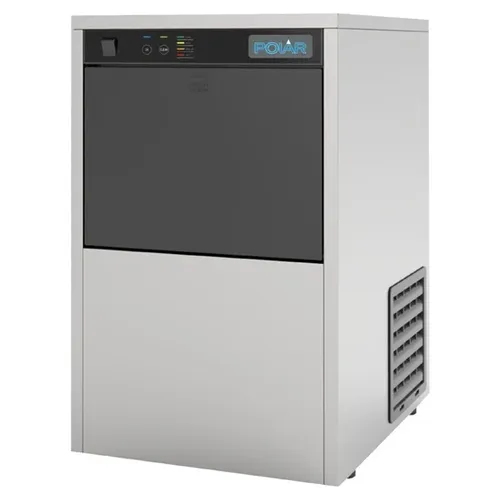
Ascot’s range covers 58 machines from £416 to £7,415 ex VAT, spanning brands trusted by UK hospitality: Hoshizaki (the global benchmark for reliability and ice clarity), Prodis (strong value across integral and modular formats), Polar (compact countertop options with UVC hygiene), and Halcyon (solid mid-range performers from 25 kg to 130 kg/24hr). Whether you’re fitting out a single bar station or speccing a hotel banqueting operation, there’s a machine in this range that fits.
Choosing the Right Ice Machine
Getting the right machine starts with three decisions: ice type, configuration, and cooling method. Here’s how to think through each one.
Ice Type and Application
- Cube ice – The standard for bars, restaurants, and general drinks service. Hard, slow-melting, and clear. Ideal for spirits, soft drinks, and cocktails. Most commercial ice cube machines produce full or half-cube formats; some Hoshizaki models produce their proprietary crescent-edge cube, which stacks efficiently and reduces splashing.
- Flake ice – Soft, mouldable, and fast-chilling. Used in fish and seafood displays, salad bars, and food prep. Also works in blenders. If you run a fishmonger counter or a fresh display, a dedicated ice flaker is the better call – see our Ice Flakers range.
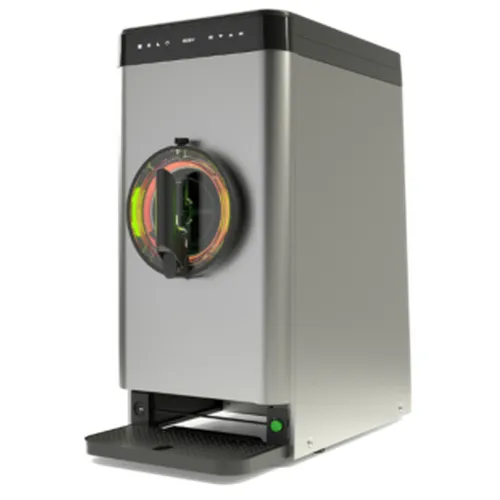
- Nugget ice – Chewable, compressible, and easy to dispense. Common in healthcare, self-serve drink stations, and high-volume soft drinks. The Hoshizaki Hydrocarbon Self-Contained Ice Nugget Maker (110 kg/24hr, £3,132 ex VAT) is the standout option in this range.
Integral vs Modular
- Integral (self-contained) machines have the refrigeration system and storage bin built into one unit. Compact, straightforward to install, and right for most bars, cafés, and restaurant ice machine setups producing up to around 130 kg/24hr.
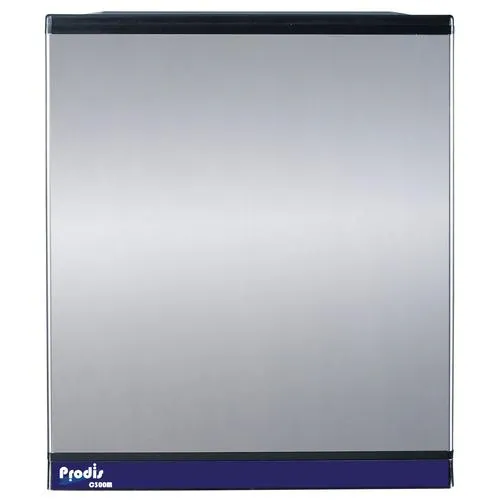
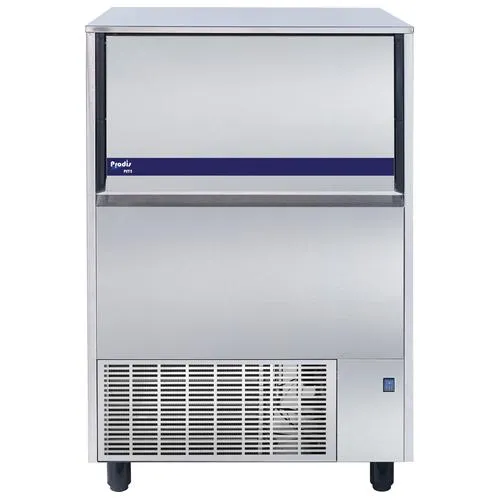
- Modular machines separate the ice-making head from the storage bin. You buy them independently, which lets you match production output to the bin capacity your operation actually needs. The Prodis Modular Ice Cube Maker 300 kg (£3,025 ex VAT) is a good example – high output, flexible bin pairing, suited to hotels, banqueting, and high-volume catering.
Air-Cooled vs Water-Cooled
- Air-cooled machines use a fan to draw ambient air across the condenser. They’re cheaper to run, easier to install, and the right default choice for most UK sites. They do need adequate clearance – typically 150 mm minimum on all sides – and the ambient temperature in the room should stay below around 38 °C.
- Water-cooled machines run water over the condenser coils instead. They perform better in hot, poorly ventilated kitchens and tend to be quieter. The trade-off: higher water consumption and a dedicated drain for condenser discharge. If your kitchen runs hot in summer, water-cooled is worth the extra plumbing.
Output Capacity by Venue Type
| Venue | Recommended output |
|---|---|
| Small café/coffee shop | 20–45 kg/24hr |
| Bar (up to 80 covers) | 45–80 kg/24hr |
| Restaurant (80–150 covers) | 80–130 kg/24hr |
| Hotel/banqueting | 130–300 kg+ /24hr |
| High-volume / industrial | Modular, 300 kg+ /24hr |
Trade Insight: Sizing and Installing a Commercial Ice Machine
Buying on daily output alone is the most common mistake. A machine rated at 130 kg/24hr doesn’t produce 130 kg in the two hours before your evening service peaks – it produces that spread across a full day. What matters is how much ice you need available at the start of your busiest period, and whether the bin holds enough to cover it.
How to size correctly:
- Estimate peak demand first. A busy bar typically uses 0.7–1.4 kg of ice per customer per service. Multiply by your expected covers at peak, then add 20% headroom for hot days and unexpected volume.
- Match bin capacity to peak demand, not daily output. If you need 40 kg available at 6 pm, your bin needs to hold at least 40 kg – regardless of what the machine produces overnight.
- Don’t undersize for cost. A machine that runs dry at 8 pm on a Saturday is far more expensive than the price difference between models.
Water filtration and limescale:
- Fit a water filter – always. In hard water areas (much of England), limescale builds up on evaporator plates and condenser coils, reducing output and shortening machine life. More critically, many manufacturer warranties are voided if limescale damage occurs without a filter in place.
- A three-stage filter (sediment, carbon, scale inhibition) is the standard recommendation for commercial ice machine suppliers across the UK trade.
Drain pump requirements:
- Most machines drain by gravity. If the machine’s waste outlet sits higher than the building’s drainage point, gravity handles it – no pump needed.
- If the drain runs uphill, you need a pump. Some Prodis models include a built-in discharge pump (e.g. the Prodis 42 kg with 15 kg bin, £1,017.50 ex VAT). Others require an external unit. Confirm your drain situation before ordering.
Ambient temperature:
- Air-cooled machines lose output in hot rooms. A machine rated at 65 kg/24hr at 21 °C ambient may produce significantly less at 32 °C. If your kitchen runs hot, either choose water-cooled or factor in a meaningful output reduction.
- Minimum ambient temperature matters too. Most machines won’t operate correctly below around 10 °C – don’t install in an unheated outbuilding or cold store corridor.
Installation space:
- Allow clearance on all sides for air-cooled units. Blocking vents is the single most common cause of reduced output and premature compressor failure.
- Plumbing connections: cold water inlet, drain outlet, and power supply should all be within practical reach – ideally within 1 metre of the machine’s connection points.
- Floor must be level. Uneven installation affects ice formation and drainage.
Why Buy from Ascot Wholesale
- Trade pricing across 58 machines – from compact countertop units at £416 ex VAT to high-output modular systems at £7,415 ex VAT, all priced for the trade without retail margin.
- Trusted brands, not filler – Hoshizaki, Prodis, Polar, Halcyon, and Carpigiani. Every machine in the range is from a manufacturer with a proven track record in UK commercial kitchens.
- Free delivery on qualifying orders – fast UK delivery direct to your site, so you’re not waiting weeks for equipment you need in service.
- B2B account support – buying for multiple sites or speccing a new kitchen? Our trade team can advise on output, configuration, and brand selection before you commit.
- Ascot Wholesale has supplied the UK hospitality trade since 1995 – we know what holds up in a working kitchen and what doesn’t.
Browse related categories: Refrigeration Equipment | Ice Flakers | Ice & Water Dispensers
Frequently Asked Questions
What size commercial ice machine do I need?
Start with your peak demand, not your daily average. Estimate how much ice you need available at the start of your busiest service – typically 0.7–1.4 kg per customer for a bar – then add 20% headroom. A small café or coffee shop generally needs 20–45 kg/24hr; a busy bar 45–80 kg; a restaurant 80–130 kg; a hotel or banqueting operation 130 kg or more. Match your bin capacity to that peak figure, not just the machine’s rated daily output.
What’s the difference between cube, flake and nugget ice?
Cube ice is hard, clear, and slow-melting – the standard for bars, restaurants, and general drinks service. Flake ice is soft and mouldable, used for fish displays, food prep, and blending. Nugget ice (also called cubelet) is chewable and easy to dispense, suited to healthcare settings and high-volume self-serve drink stations. Most hospitality operations need cube; if you run a food display or seafood counter, consider a dedicated flaker.
Air-cooled vs water-cooled: which should I choose?
Air-cooled is the right default for most UK sites – cheaper to run, simpler to install, and perfectly adequate where ambient temperatures stay below around 38 °C with good ventilation. Water-cooled suits hot, cramped, or poorly ventilated kitchens; it performs more consistently in high ambient temperatures and runs quieter, but uses more water and needs a dedicated condenser drain. If your kitchen runs hot in summer, water-cooled is worth the extra plumbing cost.
How often do I need to clean a commercial ice machine?
Most manufacturers recommend a full clean every one to three months, depending on water quality and usage. In hard water areas, more frequent cleaning and descaling is needed. Ice is classified as a food under UK food safety law, so regular cleaning isn’t just good practice – it’s a legal hygiene requirement. Keep a cleaning log and follow the manufacturer’s schedule to protect your warranty.
Do I need a water filter for a commercial ice machine?
Yes – always. A water filter protects the machine from limescale build-up, which reduces output, shortens equipment life, and can void your manufacturer’s warranty if damage occurs without one in place. In hard water areas of England, this is non-negotiable. A three-stage filter covering sediment, carbon, and scale inhibition is the standard recommendation for commercial ice machine UK installations.
What’s the difference between integral and modular ice machines?
Integral (self-contained) machines have the refrigeration system and storage bin built into one unit – compact, straightforward to install, and right for most bars and restaurants. Modular machines separate the ice-making head from the storage bin, letting you choose bin capacity independently of production output. Modular suits high-volume operations – hotels, banqueting, large restaurants – where you need more storage flexibility or higher daily output than a self-contained unit can provide.
Useful Sources
- Food hygiene for businesses – GOV.UK: ice is classified as a food item under UK food safety law; this GOV.UK guide covers hygiene standards and cleaning requirements for food businesses.
- Food and drink manufacture – HSE: HSE guidance on safe installation and operation of commercial food equipment including refrigeration.