
Up to 40% off
Glassware
Shop
Bar Accessories
Get 30% off
Tableware
Shop
Refrigeration

Save Up To 30%
Front of House
Shop
Kitchen Accessories
Shop
Catering Equipment
Shop
Cleaning
Get 30% off
Disposables
Category
- Catering Equipment Wholesale (4)
- Commercial Cooking Equipment (4)
- Contact Grills (1)
- Sandwich Grills (4)
- Commercial Cooking Equipment (4)
Brand
- Parry (1)
- Zodiac (1)
- Dualit (1)
- Hallco (1)
- Sunnex (1)
Product Type
- Grills (2)
Warranty
- 2 Years (1)
Price
Min: £
Max: £
Sandwich Grills
Showing all 4 results
-
£267.99 Ex. VAT
-
£399.99 Ex. VAT
-
£399.00 Ex. VAT
-
£336.63 Ex. VAT
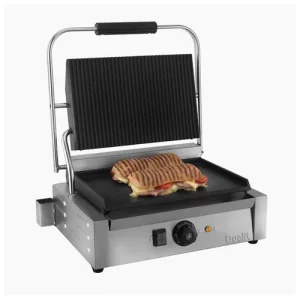
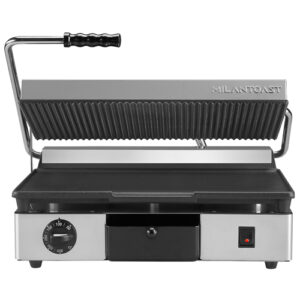
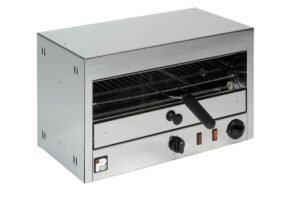
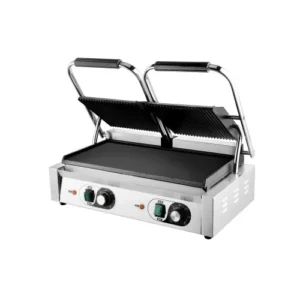
Showing all 4 results
Commercial Sandwich Grills for Cafés, Delis and Food-to-Go Kitchens
Commercial sandwich grills – also called panini grills, panini presses or toasted sandwich makers – are built for continuous daily service, not the occasional toastie at home. Cafés, delis, bistros, food trucks and grab-and-go counters all rely on them to push out paninis, toasted sandwiches and pressed wraps consistently, service after service. Commercial units run heating elements in the 1.8–3kW range, use heavy-duty stainless steel bodies and are rated for repeated back-to-back use through a full lunch rush.
Ascot Wholesale stocks commercial sandwich grills from Dualit, Hallco and Parry – single and double models, flat and ribbed plates, for cafés, delis, sandwich bars and food-to-go operations. Trade pricing, reliable stock, UK delivery.
How to Choose a Commercial Sandwich Grill
- Flat vs ribbed plates – Ribbed plates are the standard for panini grills – grill marks, fat drainage, crispier finish on bread. Flat plates suit wraps, quesadillas and delicate items where maximum surface contact matters. Reversible plate models give you both on the same unit without buying two machines.
- Single vs double – A single commercial sandwich grill suits operations running 20–30 sandwiches per day. A double unit runs two independent cooking surfaces simultaneously – double the throughput, one surface can cool for cleaning without stopping service. For any site running a serious lunch trade, a double pays for itself quickly.
- Wattage and power supply – Most single commercial sandwich grills run at 1.8–2kW on a standard 13-amp socket. Double units typically run at 3–3.6kW and may require a 16-amp supply. Check the power requirement before ordering – a double unit on an undersized circuit trips the breaker mid-service.
- Floating hinge – A floating hinge adjusts automatically to the thickness of the food – thick ciabattas and stuffed paninis cook evenly without manual adjustment. Fixed hinge models suit operations running a consistent, uniform product.
- Non-stick vs standard plates – Non-stick plates (Hallco Large Single Panini Non-Stick) clean faster and suit operations where close-down speed matters. Standard plates are more durable under heavy daily use. For a high-volume lunch operation, durability outweighs clean-down convenience.
Trade Insight
Plate choice defines the product. Ribbed plates create grill marks and drain fat – the right choice for a panini or pressed chicken sandwich where presentation matters. Flat plates maximise surface contact and suit wraps, quesadillas and items where even cooking across the full surface is more important than grill marks. Reversible plate models cover both without the cost of two units – the practical choice for a café running a varied menu.
Single vs double is a throughput decision, not a budget decision. A single commercial sandwich grill running a busy lunch service creates a queue – one panini at a time, 3–4 minutes per cycle. A double unit runs two simultaneously. The capital cost difference between a single and double Dualit or Hallco unit is recovered in the first busy week of service. Size to your peak lunch cover count, not your quietest shift.
Wattage and power supply must be checked before ordering. A double commercial sandwich grill running at 3.6kW on a 13-amp socket trips the circuit mid-service. Check the power requirement on the spec sheet and confirm your circuit capacity before ordering. Most UK café counters run on 13-amp sockets – a single unit fits; a double may need a 16-amp dedicated circuit.
Clean-down between services extends plate life significantly. Wipe plates while still warm – not hot – after every service. Burnt residue left to cool and harden requires more aggressive cleaning that damages the plate surface over time. On ribbed plates, use a brass wire brush to clear the grooves. On non-stick plates, use a soft cloth only – abrasive cleaning destroys the coating within weeks.
Why Buy from Ascot Wholesale
- Competitive trade pricing – across the full commercial sandwich grill and panini press range.
- Trusted brands – Dualit, Hallco and Parry, used daily in real UK café and deli operations.
- Flat, ribbed and reversible plate models – single and double, with floating hinge options for varied menus.
- Free delivery on qualifying orders – across the UK mainland.
- Trade accounts for regular buyers – cafés, delis and food-to-go operations placing ongoing orders.
- 25 years supplying UK hospitality – trade authority built on real commercial experience across cafés, sandwich bars and food-to-go operations.
Browse our full Cooking Equipment range, or explore related categories: Contact Grills and Commercial Toasters.
Frequently Asked Questions
What is the difference between a commercial sandwich grill and a panini grill?
Commercial sandwich grill and panini grill refer to the same type of equipment – a countertop unit with heated upper and lower plates that press and cook food from both sides simultaneously. The terms are used interchangeably. “Panini grill” or “panini press” is common in café settings; “sandwich grill” or “toasted sandwich maker” is the broader term covering all plate types and sizes.
What wattage do I need for a commercial sandwich grill?
Single commercial sandwich grills typically run at 1.8–2kW on a standard 13-amp socket. Double units run at 3–3.6kW and may require a 16-amp dedicated circuit. Check the power requirement on the spec sheet before ordering – a double unit on an undersized circuit will trip the breaker mid-service.
What is the difference between single and double commercial sandwich grills?
A single commercial sandwich grill cooks one sandwich at a time – suited to operations running 20–30 sandwiches per day. A double unit runs two independent cooking surfaces simultaneously, doubling throughput on the same counter footprint. For any café or deli running a serious lunch trade, a double unit is the practical choice.
Should I choose flat or ribbed plates on a commercial panini grill?
Ribbed plates are the standard for panini grills – grill marks, fat drainage, crispier finish on bread. Flat plates suit wraps, quesadillas and items where maximum surface contact matters more than grill marks. Reversible plate models give you both options on the same unit without buying two machines.
Can I use a commercial panini grill on a standard 13-amp socket?
Single commercial panini grills running at 1.8–2kW work on a standard 13-amp socket. Double units running at 3–3.6kW typically require a 16-amp dedicated circuit. Always check the power requirement on the spec sheet before ordering and confirm your circuit capacity with a qualified electrician if in doubt.
How do I clean a commercial sandwich grill safely?
Wipe plates while still warm – not hot – after every service using a damp cloth. For ribbed plates, use a brass wire brush to clear the grooves. For non-stick plates, use a soft cloth only – abrasive cleaning destroys the coating. Never immerse the unit in water. Unplug before cleaning and allow to cool to a safe handling temperature before deep-cleaning the exterior.