

Up to 40% off
Glassware
Shop
Bar Accessories
Get 30% off
Tableware
Shop
Refrigeration

Save Up To 30%
Front of House
Shop
Kitchen Accessories
Shop
Catering Equipment
Shop
Cleaning
Get 30% off
Disposables
Category
- Catering Equipment Wholesale (2)
- Commercial Food Preparation Equipment (2)
- Catering Scales (2)
- Commercial Food Preparation Equipment (2)
Brand
- Uropa (1)
- Nevilles (1)
- Genware (1)
Product Type
- Scales (2)
Price
Min: £
Max: £
Catering Scales
Showing all 2 results
-
Was £65.30.
£45.71 Ex. VAT Now £45.71.

Showing all 2 results
Catering Scales for Restaurants and Professional Kitchens
Catering scales handle the accurate weighing that consistent portioning, recipe control and food cost management depend on – across every prep session, every service, every day. Digital kitchen scales suit general prep weighing, portioning and recipe batching – precise, easy to read, and straightforward to zero between portions. Analogue scales suit heavier loads where durability and mechanical reliability matter more than digital precision – robust, battery-free, and built for sustained daily use in busy prep environments.
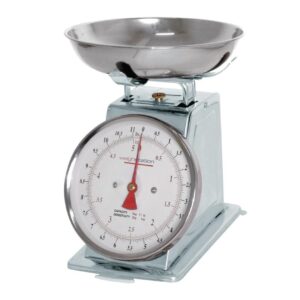
Ascot Wholesale stocks catering scales from GenWare and Weighstation – the GenWare Analogue Scales at 20kg capacity for heavy-duty prep and bulk weighing, and the Weighstation Large Kitchen Scale at 5kg capacity for accurate portioning and recipe work. Trade pricing, reliable stock, UK delivery.
How to Choose Catering Scales
- Analogue vs digital – Analogue scales use a mechanical spring mechanism – no batteries, robust construction, suited to heavier loads and environments where digital displays are impractical. Digital scales use an electronic sensor for precise readings – suited to recipe work, portion control and prep tasks where accuracy to the gram matters. For most professional kitchens, a digital scale handles day-to-day recipe and portioning work; an analogue scale covers bulk weighing of heavier ingredients.
- Capacity – Match the scale capacity to your heaviest regular load. The Weighstation 5kg scale suits standard portioning and recipe batching. The GenWare 20kg analogue scale suits bulk ingredient weighing – flour, sugar, rice, pulses – where a 5kg scale would require multiple batches. Always size to your heaviest load, not your lightest portion.
- Accuracy and graduation – Digital scales read to 1g or finer – suited to precise recipe work and consistent portioning. Analogue scales read to the nearest graduation mark – suited to bulk weighing where gram-level precision is not required. Check the graduation interval against your most precise weighing task before ordering.
- Platform size – A small platform limits the size of bowl or container you can weigh on. Check the platform dimensions against your largest regular prep bowl – a platform that is too small forces you to decant product before weighing, adding prep time and increasing waste.
- Ease of cleaning – Scales used in a commercial kitchen must be cleaned regularly. Look for smooth platform surfaces, removable drip trays and sealed displays. Clean the platform immediately after use – dried food residue on the platform surface affects tare accuracy and creates a hygiene risk.
Trade Insight
Accurate portioning is one of the most direct levers on food cost in a professional kitchen. A kitchen that portions by eye loses margin on every plate – over-portioning adds cost; under-portioning affects customer satisfaction and review scores. A catering scale on every prep station removes the guesswork and produces consistent portions across every cook and every service.
The GenWare 20kg analogue scale is built for bulk ingredient weighing in high-throughput kitchens. At 20kg capacity with mechanical spring construction, it handles flour, sugar, rice and bulk dry goods without batteries or electronic components to fail. A reliable workhorse for bakeries, production kitchens and catering operations running large batch prep daily.
The Weighstation 5kg digital scale suits accurate recipe and portioning work. At 5kg capacity with a large, easy-to-read display, it handles standard prep weighing – protein portions, sauce batching, pastry work and ingredient measuring – with the precision that consistent recipe output requires. At £23.09 ex. VAT it is one of the most cost-effective pieces of equipment on any prep bench.
Level the platform before zeroing. Scales on an uneven bench never zero accurately – a platform that is not level introduces a consistent error into every reading. Check the bench surface is level before placing the scale, zero the display with the empty bowl or container in place, and re-zero between portions. Clean the platform while residue is still wet – dried food on the platform surface affects tare accuracy and is harder to remove without damaging the platform finish.
Why Buy from Ascot Wholesale
- Competitive trade pricing – across the GenWare and Weighstation catering scales range.
- Analogue and digital models – GenWare 20kg analogue for bulk weighing, Weighstation 5kg digital for accurate portioning and recipe work.
- Built for commercial kitchens – robust construction suited to daily use in professional prep environments.
- Free delivery on qualifying orders – across the UK mainland.
- Trade accounts for regular buyers – restaurants, contract caterers and catering kitchens placing ongoing orders.
- 25 years supplying UK hospitality – trade authority built on real commercial experience across restaurants, hotel kitchens and production operations.
Browse our full Food Preparation Equipment range, or explore related categories: Commercial Food Processors and Commercial Food Mixers.
Frequently Asked Questions
What is the difference between analogue and digital catering scales?
Analogue scales use a mechanical spring mechanism – no batteries required, robust construction, suited to heavier loads and environments where digital displays are impractical. Digital scales use an electronic sensor for precise readings to the gram – suited to recipe work, portion control and prep tasks where accuracy matters. For most professional kitchens, a digital scale handles day-to-day recipe and portioning work; an analogue scale covers bulk weighing of heavier ingredients.
What capacity catering scales do I need?
Match the capacity to your heaviest regular load. A 5kg scale suits standard portioning and recipe batching for most restaurant and catering kitchens. A 20kg scale suits bulk ingredient weighing – flour, sugar, rice and dry goods – where a 5kg scale would require multiple batches. Always size to your heaviest single load, not your lightest portion.
How accurate do catering scales need to be for a professional kitchen?
For recipe and portioning work, digital scales accurate to 1g are sufficient for most professional kitchen tasks. For pastry and baking where precise ratios matter, scales accurate to 0.1g may be required – check the graduation interval on the product spec. For bulk ingredient weighing, analogue scales accurate to the nearest 50g or 100g graduation are sufficient.
How do I zero catering scales correctly?
Place the empty bowl or container on the platform, then press the tare or zero button to reset the display to zero. This subtracts the weight of the container from all subsequent readings. Re-zero between each portion to maintain accuracy. Check the platform is level before zeroing – scales on an uneven surface introduce a consistent error into every reading.
What are the hygiene requirements for catering scales in a commercial kitchen?
Catering scales must be kept clean and free from food residue under UK food hygiene regulations. Clean the platform surface after every use – dried food residue affects tare accuracy and creates a cross-contamination risk. Use a food-safe sanitiser on the platform and surrounding surfaces. Check manufacturer guidance for waterproofing ratings before cleaning with wet cloths or sprays on digital models.
Can catering scales be used for allergen portioning?
Yes, but dedicated scales should be used for allergen-containing ingredients to prevent cross-contamination. A scale used for nut-based ingredients, for example, should be cleaned and sanitised thoroughly before use with allergen-free products – or a separate dedicated scale should be used. HACCP procedures should identify scales as a potential cross-contamination point and specify cleaning protocols between allergen and non-allergen use.